History of Amsterdam (2026): from origins to a modern capital
Things to do in Amsterdam | Posted on 24 February 2026
Last updated: February 2026
The history of Amsterdam begins in the 13th century, when a small settlement near a dam in the Amstel River gradually developed into the capital of the Netherlands. This guide provides a structured and chronological overview of Amsterdam’s origins in 1275, the granting of city rights in 1306, the Dutch Golden Age and the VOC, the construction of the canal ring, the 19th century when Amsterdam became the capital in 1814, the Second World War and the city’s modern development up to 2026. If you want to experience this historic city from the water, you can explore the canals during a Luxury Saloon Boat Cruise.
TLDR / quick answer
- 1275: first official mention in the toll privilege of Floris V
- 1306: Amsterdam receives city rights
- 17th century: Dutch Golden Age, VOC-era trade and major canal expansion
- 1814: Amsterdam becomes the official capital of the Netherlands
- 2026: roughly 920,000 residents and around 100 km of canals
Best for
- students: who need clear dates and a structured overview
- visitors: who want historical context before exploring the city
- readers: searching for when Amsterdam was founded and how it began
- culture fans: interested in Rembrandt and the Dutch Golden Age
- anyone: who wants quick answers, tables and a fact-based FAQ
Chronological timeline
| Year / period | Event | Why it matters |
|---|---|---|
| 1275 | first written record of “Amestelledamme” | earliest official reference to Amsterdam |
| 1306 | city rights granted | official status as a city |
| 1602 | VOC founded | global trade networks accelerate Amsterdam’s growth |
| 1613 | start of the canal ring expansion | planned urban growth and water-based transport |
| 1662 | major canal expansion largely completed | Amsterdam’s canal structure takes its famous form |
| 1814 | Amsterdam becomes capital | constitutional and ceremonial status |
| 1940–1945 | Second World War | occupation, persecution and post-war recovery |
| 2018 | North/South metro line opens | major modern infrastructure milestone |
How Amsterdam was founded
Amsterdam originated around a dam built in the Amstel River, located where Dam Square stands today. The dam helped control water levels and created a logical crossing point where trade could concentrate.
When was Amsterdam founded: the first official written record dates to 1275, linked to the toll privilege of Floris V.
What was Amsterdam called before: “Amestelledamme”, meaning a dam in the Amstel.
When was Amsterdam established as a city: in 1306, the settlement was granted city rights.
The Dutch Golden Age and the VOC
In the 17th century, Amsterdam became one of Europe’s leading trading cities. A useful museum overview of this period is the Rijksmuseum’s section on the 17th century.
The VOC (Dutch East India Company) was founded in 1602. If you want a quick, reliable English background page, see Dutch East India Company (VOC). Around the mid-1600s, Amsterdam’s population reached roughly 200,000, making it one of the largest cities in Europe.
Rembrandt lived and worked in Amsterdam. His former residence is now the Rembrandt House Museum. You can also explore locations connected to the era during the Rembrandt Cruise.
The canal ring: construction and UNESCO status
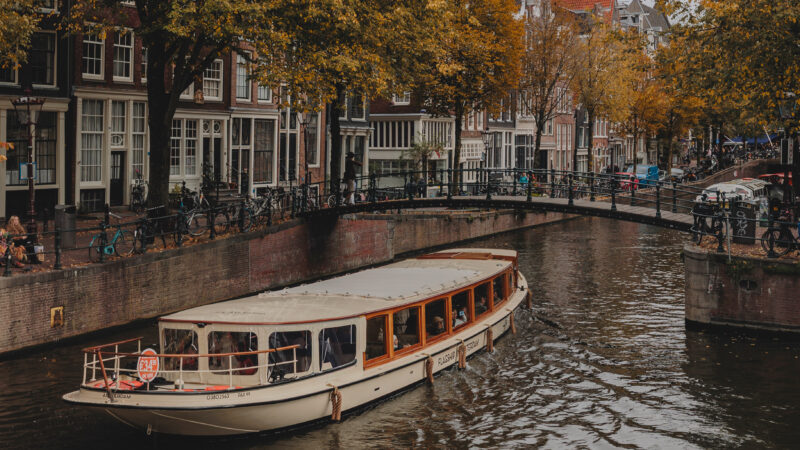
The canal ring was constructed starting in 1613 as a planned urban expansion. The main canals are Herengracht, Keizersgracht and Prinsengracht.
Oldest canal: Oudezijds Voorburgwal is commonly described as one of Amsterdam’s oldest canals.
How many canals: approximately 165.
Canals and waterways length: about 100 km of canals and more than 1,200 bridges.
In 2010, the canal ring was added to the UNESCO World Heritage List.
Comparison table
| Period | Economy | Population trend | Key feature |
|---|---|---|---|
| Middle Ages | regional trade and shipping | small, growing | dam and harbour function |
| Dutch Golden Age | global trade and finance | rapid growth | canal expansion and arts |
| 19th century | industry and infrastructure | urbanisation | railways and new districts |
| 21st century | tech, services and finance | international city | Zuidas and metro upgrades |
Why Amsterdam is the capital
Amsterdam became the official capital in 1814. The government and parliament are located in The Hague, which has long been the administrative centre. For a clear fact-based summary, see Britannica: Amsterdam.
Amsterdam during the Second World War
In May 1940, the Netherlands was occupied by Nazi Germany. Amsterdam had a large Jewish community before the war. More than 60,000 Jewish residents were deported. The Anne Frank House provides detailed background and education on this period.
Population growth and city districts
The population grew in waves. A common historical estimate is roughly 30,000 residents around 1400 and around 200,000 by the mid-1600s. In 2026, Amsterdam has roughly 920,000 inhabitants.
Oldest district: the historic core formed around the Oude Kerk area.
Modern expansions: Plan Zuid in the early 20th century, Nieuw-West after 1945, IJburg from 1999 and the Zuidas business district.
Economy: from trade to technology and finance
Amsterdam’s economy evolved from global trade in the 17th century to industrial growth in the 19th century and a modern mix of financial services and technology in the 21st century.
Transport and infrastructure
Amsterdam Central Station opened in 1889. For a stable English reference page, see Amsterdam Centraal station.
The North/South metro line opened in July 2018. A stable English reference page is Line 52 (North/South Line).
FAQ about the history of Amsterdam
When was Amsterdam founded
1275.
When did Amsterdam receive city rights
1306.
What was Amsterdam originally called
Amestelledamme.
What does the name Amsterdam mean
It refers to a dam in the Amstel River.
When was the VOC founded
1602.
When did canal construction begin
1613.
When did Amsterdam become the capital
1814.
What is the oldest canal in Amsterdam
Oudezijds Voorburgwal.
How many canals does Amsterdam have
Approximately 165.
How long are Amsterdam’s canals
About 100 kilometres.
How many bridges are there in Amsterdam
More than 1,200.
What is Amsterdam known for
Its canals, Dutch Golden Age heritage, trade history, museums and international culture.